
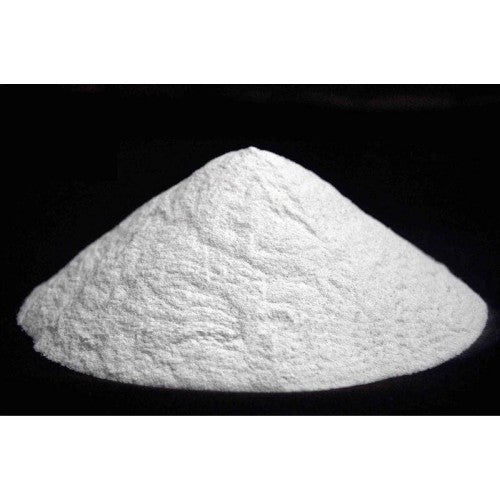
High-Tensile PTFE (Polytetrafluoroethylene) Powder for Dry Battery Electrode Binder, 50-200 g/bottle, CDBEBHTPTFE
Delivery and Shipping to EU
Delivery and Shipping to EU
We will add in the quotation, the shipping, insurance, customs clearance costs.
High-Tensile PTFE (Polytetrafluoroethylene) Powder for Dry Battery Electrode Binder, 50-200 g/bottle, CDBEBHTPTFE
Thasar S.r.l.
High-tensile, fibrillating Polytetrafluoroethylene (PTFE) powder serves as the critical dry binder for Solvent-Free Dry Battery Electrode (DBE) manufacturing. Unlike traditional slurry-cast binders that rely on liquid dissolution, dry-process PTFE utilizes ultra-high molecular weight polymer chains that undergo mechanical shear-induced orientation. (1) Fibrillation Behavior: Under intensive dry mechanical shear (such as high-speed shearing, jet-milling, or twin-screw extrusion), the crystalline domains of the PTFE particles uncoil and stretch into a robust, interconnected nano-fibrous "spider-web" network. (2) Mechanical Reinforcement: This web physically traps active material particles (e.g., high-nickel NCM, silicon-carbon, or sulfur) and conductive carbon additives (Super P, VGCF, CNTs), providing high tensile strength and structural integrity to freestanding electrode films without requiring liquid solvents or drying ovens. (3) Electrochemical Stability: Exhibits exceptional resistance to high oxidation voltages (> 4.5 V vs. Li/Li+) and broad thermal stability up to 250 °C, making it compatible with both liquid carbonate electrolytes and sulfide/oxide solid-state systems.
| Part Number |
CDBEBHTPTFE (C-DBEB-HTPTFE) |
| CAS |
9002-84-0 |
| Chemical Formula |
(CF2CF2)n  |
| Appearance |
White Powder |
| Molecular Weight |
~7700000 |
| Bulk Density |
537 g/L |
| Average Size |
~450 um |
| Specific Weight |
2.149 |
| Melting Point |
327 °C |
| Extrusion Pressure |
~30 MPa |
| Tensile Rate |
>300% |
| Package Size | 50 g, 100 g, and 200 g/bottle |
Notes: Please try to store the PTFE powders in a dry place (glovebox is the best option).
- K. H. Lee, et al. Dual-fibrous PTFE structure enabling uniform and thick dry electrodes for high-energy-density and long-lasting batteries, Energy Environ. Sci. (2025) 18 (18): 8446–8461.
- K. E. Sung, et al. Enhanced adhesion in PTFE-based dry electrodes with hydrogen bonding co-binder integration for advanced lithium-ion batteries, Chem. Engineering J., 2025, 511, 161789.
